
Facing Trauma: How Trauma Affects the Mind, Body, and Relationships

Trauma is a word we hear often, but many people still struggle to understand what it truly means, or how deeply it can influence daily life. For some, trauma is tied to a specific event. For others, it develops quietly over time through experiences that never felt safe, supportive, or fully resolved.
At Gooding Wellness Group, we frequently work with individuals who aren't interested in simply revisiting the past, but rather in figuring out how to move beyond it. They want to understand why their anxiety persists, why their relationships drain them, or why their body never seems able to fully relax.
This blog explores what trauma really is, how it affects the mind and body, and why it so often shows up in relationships and work. It also introduces our Facing Trauma email micro-course, created to offer education, clarity, and practical tools for healing.
What Trauma Really Is (And What It Isn’t)
Trauma is not defined by how dramatic or visible an experience appears from the
outside. It is defined by how the nervous system experiences overwhelm.
Trauma Is Defined by the Nervous System, Not the Event

Trauma occurs when something feels too much, too fast, or too soon and the body doesn’t have the support or capacity to process it fully. This may involve a single overwhelming event, such as an accident or sudden loss, or chronic stress like emotional neglect, instability, or ongoing criticism.
Two people can experience the same event and respond very differently. This difference is not about strength or weakness, it reflects biology, history, timing, and available support.
Why Trauma Affects People Differently
No two nervous systems are the same. Early experiences, attachment relationships, genetics, and past stress all shape how the body responds to threat.
The Role of Biology, Environment, and Support
When a person has consistent emotional support, their nervous system is more likely to recover after stress. When support is limited or inconsistent, the body may stay in survival mode longer. This is why trauma responses can persist even when life looks “fine” on the surface.
How Trauma Impacts the Mind and Brain
Trauma changes how the brain functions—often in ways people don’t realize.
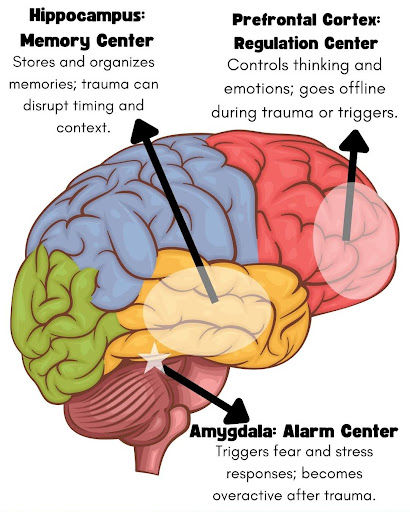
The Amygdala, Hippocampus, and Prefrontal Cortex
The amygdala becomes more reactive, constantly scanning for danger.
The hippocampus may struggle to organize memories, making the past feel present.
The prefrontal cortex, responsible for reasoning and emotional regulation, can go offline during stress.
These changes help explain anxiety, emotional reactivity, difficulty concentrating, and feeling “on edge” without knowing why.
How Trauma Lives in the Body
Trauma is not just psychological—it is deeply physical.
The Stress Response and the Nervous System
When trauma activates the body’s stress response, hormones like cortisol and adrenaline flood the system. For some people, this system never fully resets. The result may be chronic tension, fatigue, digestive issues, sleep problems, or pain with no clear medical cause.
This is why trauma is often described as being “stored in the body.” Healing must involve the nervous system, not just thoughts.
Big “T” and Little “t” Trauma—Why the Labels Matter Less Than the Impact
Big “T” trauma often refers to sudden, life-threatening events. Little “t” trauma refers to chronic or relational stress that accumulates over time.
While these terms can be useful clinically, they can also unintentionally minimize experience. The nervous system does not measure trauma by size, it responds to overwhelm. Chronic emotional stress can impact the brain and body just as powerfully as a single dramatic event.
Trauma is trauma. Comparison only delays healing.
How Trauma Affects Relationships
Trauma often becomes most visible in close relationships.

Trust, Intimacy, Attachment, and Communication
People may struggle with intimacy, trust reassurance less easily, or feel overwhelmed by conflict. Attachment patterns formed early in life can lead to fear of abandonment, discomfort with closeness, or both.
These patterns are not flaws—they are adaptations developed to survive earlier environments.
How Trauma Shows Up at Work and in Daily Life
Work environments can activate trauma responses due to stress, authority, feedback, and uncertainty. Trauma may show up as perfectionism, overworking, fear of mistakes, difficulty with boundaries, or heightened sensitivity to criticism.
These patterns reflect nervous system survival—not incompetence.
Why Understanding Trauma Is the First Step Toward Healing
When people understand trauma through a biological and relational lens, shame often softens. Patterns begin to make sense. Self-blame gives way to compassion.
Healing does not begin with fixing—it begins with understanding.
What You’ll Learn in the Facing Trauma Micro-Course

The Facing Trauma micro-course is a free, 7-day email series designed to help individuals understand trauma and begin building tools for healing.
Subscribers receive one email per day covering:
what trauma really is
how it affects the nervous system and body
why trauma shows up in relationships and work
practical tools for regulation and grounding
how trauma-informed therapy supports healing
The series is educational, compassionate, and designed to meet readers where they are. Click here to subscribe and begin receiving the series today.
Interested in Learning More?
If you’re seeking clarity, validation, or a gentle place to begin, the Facing Trauma micro-course may be a meaningful next step. Click below to subscribe to the free course. If you need further support, our team of clinicians are standing by to help. Contact us anytime.

Submitted by Gordon Gooding, LCSW


Comments